
.png
)
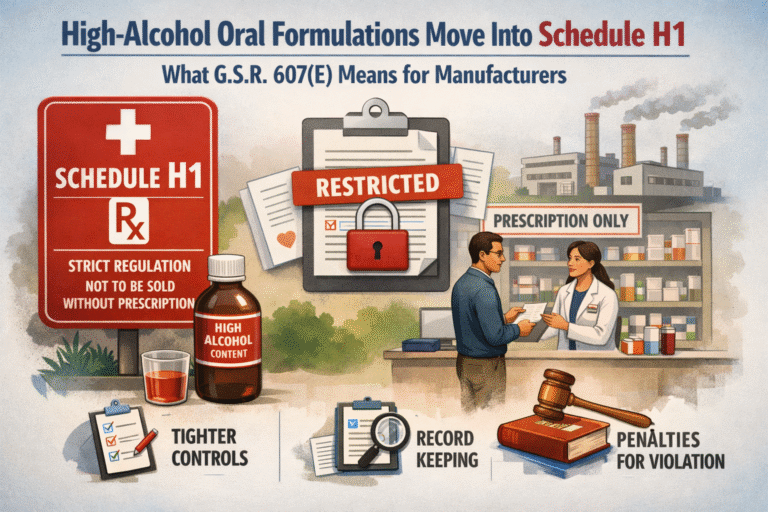
High-Alcohol Oral Formulations Move Into Schedule H1: What G.S.R. 607(E) Means for Manufacturers
The Drugs (Tenth Amendment) Rules, 2026 tighten the exemption net around alcohol-based oral medicines — and bring a familiar public health concern squarely into prescription-drug territory.
On 8th July 2026, the Ministry of Health and Family Welfare notified the Drugs (Tenth Amendment) Rules, 2026 vide G.S.R. 607(E), finalising a change that has been in the pipeline since October last year. The amendment does two precise things to the Drugs Rules, 1945: it narrows an exemption in Schedule K, and it adds a new entry to Schedule H1. Both changes target the same category of product — oral formulations containing more than 12% alcohol v/v (ethyl alcohol), packed and sold in packings or bottles of more than 30 millilitres.
If your portfolio includes cough syrups, tonics, digestive formulations, or any other liquid oral medicine that relies on ethanol as a solvent or preservative at this concentration and pack size, this notification changes your regulatory obligations — and your compliance timeline is shorter than it looks.
From Draft to Final Rule: The Timeline
What Exactly Changes in the Drugs Rules, 1945
1. Schedule K — Exemption Narrowed
Schedule K lists categories of drugs exempted, to varying extents, from certain provisions of the Drugs and Cosmetics Act and Rules. Serial No. 10 of Schedule K previously granted a broad exemption. The amendment carves out an exception within that exemption: the words "Act and rules thereunder" are now followed by a specific exclusion for all oral formulations containing more than 12% alcohol v/v (ethyl alcohol), packed and sold in packings or bottles of more than 30 millilitres.
In practical terms, products meeting this description can no longer rely on the Schedule K exemption that many alcohol-based liquid orals previously enjoyed.
2. Schedule H1 — New Entry 52
Schedule H1 is reserved for habit-forming and higher-risk drugs subject to stricter dispensing, labelling, and record-keeping requirements — the same schedule that covers select antibiotics, psychotropics, and, as of a recent amendment, Pregabalin (Entry 51). A new entry has now been inserted immediately after Pregabalin:
This is the substantive shift. Once a product falls under Schedule H1, it attracts the full compliance regime that comes with that classification.
What Schedule H1 Classification Requires
| Requirement | Practical Impact |
|---|---|
| Sale only on prescription | Retail pharmacies cannot sell the product over the counter; a registered medical practitioner's prescription becomes mandatory. |
| Mandatory H1 warning box on label | Packaging and labelling must be updated to carry the prescribed Schedule H1 symbol and warning statement. |
| Separate prescription register | Retailers must maintain a dedicated record of every sale — patient name, prescriber details, quantity — retained for the prescribed period. |
| Distribution-chain scrutiny | Wholesalers and stockists handling Schedule H1 products face closer inventory and sales-record expectations during inspections. |
Why This Category, and Why Now
Oral formulations with high alcohol content sold in large-volume bottles have been a recurring public health concern — not for their intended therapeutic use, but for documented patterns of misuse where such products are consumed for their alcohol content rather than their medicinal effect. Restricting the pack size threshold (above 30 ml) and alcohol concentration threshold (above 12% v/v) targets exactly the products most associated with this risk, while leaving lower-strength or genuinely small-pack formulations — such as paediatric drops — outside the new restriction.
This amendment sits alongside a broader pattern this year of the government tightening controls on categories prone to misuse or diversion, including recent amendments to Schedule H2 and continued scrutiny of narcotic and psychotropic-adjacent formulations.
Effective Date: The Six-Month Runway
Action Points for Manufacturers and Marketers
- Audit your portfolio against the 12% v/v alcohol and 30 ml pack-size thresholds — assess formulation-by-formulation and SKU-by-SKU, since pack size variants of the same formulation may fall on either side of the line.
- Re-evaluate formulation strategy — consider whether reformulating below 12% v/v, or repacking below 30 ml, is commercially viable for affected SKUs before the deadline.
- Update artwork and labelling to incorporate the Schedule H1 warning box and symbol for products that will remain above threshold.
- Brief your distribution network — wholesalers, stockists, and retail partners need advance notice that prescription-only status and register-keeping obligations will apply from the effective date.
- Review existing stock and transition planning — align production, packing, and dispatch schedules so that non-compliant stock does not remain in the trade channel after the cut-over date.
- Update SOPs and sales training for field teams who interact with retail chemists, given the shift from over-the-counter to prescription-only status.
The Bottom Line
G.S.R. 607(E) is a narrowly targeted amendment, but its impact on affected manufacturers is significant: what could previously be sold over the counter under a Schedule K exemption will, from January 2027, require a prescription, dedicated record-keeping, and revised labelling under Schedule H1. With a six-month runway and a clearly defined threshold, this is a compliance task best started now — formulation review, artwork changes, and distribution-partner communication all take longer than they appear to on paper.
Need Help Navigating This Amendment?
Vaayath Consulting Services assists pharmaceutical manufacturers with regulatory impact assessments, Schedule H1 labelling compliance, and CDSCO/state licensing authority correspondence. If this amendment affects your portfolio, our regulatory affairs team can help you map affected SKUs and build a compliance timeline well ahead of the January 2027 deadline.

