
.png
)
⚠ Regulatory Alert
Drug residues in shrimp exports have triggered a sweeping directive from CDSCO, putting state drug controllers on notice to act — or face more international trade fallout.
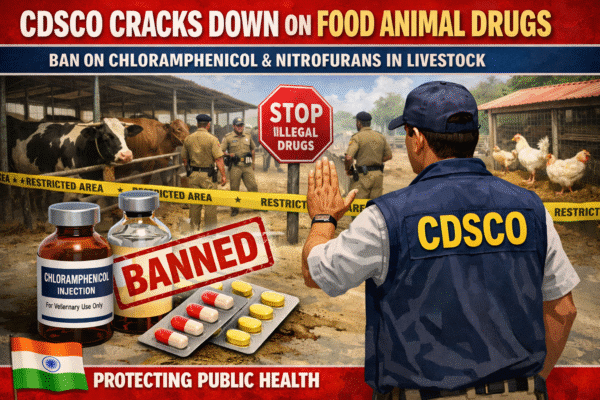
India’s Central Drugs Standard Control Organization (CDSCO) has issued an urgent directive prohibiting the import, manufacture, sale, distribution, and use of drug formulations containing Chloramphenicol or Nitrofurans in any food-producing animal rearing system — with immediate effect.
The order, signed by Drugs Controller General (India) Dr. Rajeev Singh Raghuvanshi and addressed to all State and Union Territory Drugs Controllers, comes in response to mounting international concern over antibiotic residues detected in Indian seafood exports.
The Problem: A Trade Crisis in the Making
Despite a formal ban on Chloramphenicol and Nitrofurans under Notification S.O. 1158 dated 12 March 2025, residues of these substances have continued to surface in shrimp consignments sent abroad. The impact on India’s export sector has been severe.
The Director of MPEDA (Marine Products Export Development Authority) wrote to CDSCO on 27 January 2026, flagging the scale of the problem and requesting urgent data on enforcement actions. Other states involved include Odisha (13%), West Bengal (8.7%), and Gujarat (4.3%).
The continued presence of banned drug residues in export consignments directly threatens India’s standing as a seafood exporter — undermining years of market access earned with major trading partners in Europe, North America, and East Asia.
What CDSCO Is Asking States to Report
MPEDA’s letter to CDSCO sought specific information from state authorities, and the new directive instructs states to provide it promptly:
- The current mechanism for implementing the March 2025 ban notification across each state or UT.
- The number of inspections conducted at veterinary medical shops and related establishments, along with their outcomes.
- Details of any punitive actions initiated or completed against violators under existing law.
What Businesses Must Know
The directive makes clear that Chloramphenicol and Nitrofuran formulations may only be sold to licensed manufacturers (bulk and formulation) for sale and distribution through licensed premises, strictly for their intended purpose, with proper reconciliation of stock.
Any violations will invite regulatory action under the Drugs & Cosmetics Act, 1940, and the Rules framed thereunder in 1945. Farms, veterinary suppliers, and distributors operating in aquaculture states should review their procurement and usage records immediately.
Who Else Received This Directive
Beyond State Drug Controllers, copies were sent to: the Ministry of Health and Family Welfare (JS-R), DGHS, MOEF & CC, IVRI & DAHD, all Zonal and Sub-Zonal CDSCO offices (with instructions to coordinate with respective State/UT Drug Controllers), and the Director, MPEDA.

