
.png
)
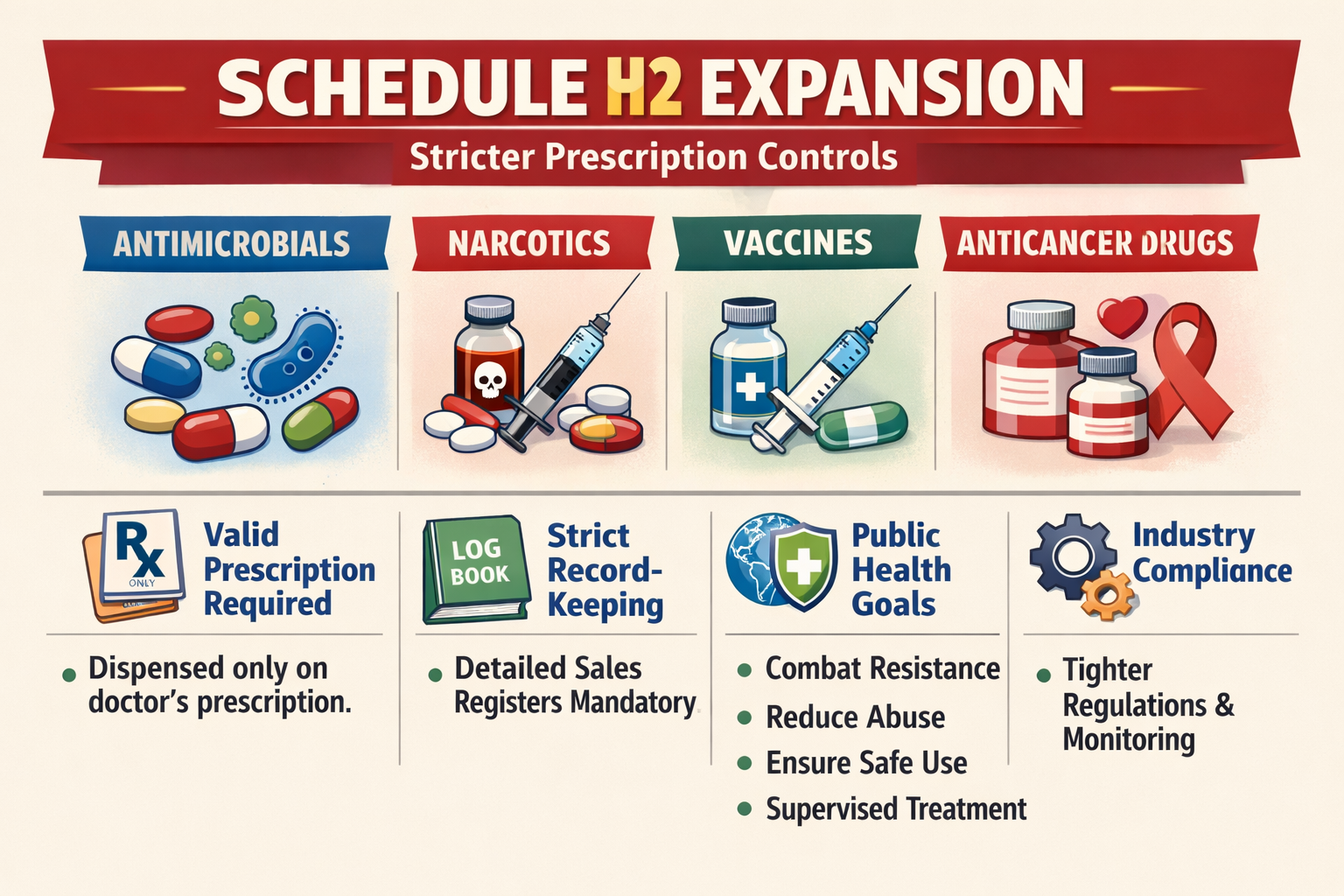
Schedule H2 Expanded: Vaccines, Antimicrobials, Narcotic Drugs & Anticancer Medicines Now Under Stricter Prescription Controls
What Has Changed?
The Ministry of Health and Family Welfare (MoHFW) published G.S.R. 506(E) in the Gazette of India Extraordinary on 22 June 2026, formally enacting the Drugs (Seventh Amendment) Rules, 2026. The notification amends Schedule H2 of the Drugs Rules, 1945 — which governs prescription-only medicines requiring additional recordkeeping obligations — by inserting a new Table 2 covering four broad therapeutic categories.
Until now, Schedule H2 principally covered specific identified drugs (Table 1). The amendment introduces a category-level inclusion, bringing entire classes of medicines under the same stringent dispensing regime.
The New Table 2: Four Categories Now Covered
| S. No. | Therapeutic Category | Effective Date |
|---|---|---|
| 1 |
All Vaccines
Includes all scheduled and non-scheduled vaccines for human use
|
1 July 2027 |
| 2 |
All Antimicrobials
Antibiotics, antifungals, antivirals, antiparasitics — all formulations
|
1 July 2028 (deferred by one year) |
| 3 |
All Narcotic Drugs & Psychotropic Substances
As listed under the NDPS Act, 1985 and rules thereunder
|
1 July 2027 |
| 4 |
All Anticancer Drugs
All oncology formulations including cytotoxic and targeted therapies
|
1 July 2027 |
While all other categories come into force on 1 July 2027, the inclusion of All Antimicrobials (Serial No. 2 of Table 2) is deferred to 1 July 2028 — likely to allow the trade and supply chain adequate time to align with the prescription and record-keeping requirements for this extremely large product category.
Background: What Is Schedule H2?
Schedule H2 is a restrictive category under the Drugs Rules, 1945, sitting above Schedule H. It imposes additional obligations on retail pharmacists: prescriptions for Schedule H2 drugs must be retained, recorded in a register, and can only be dispensed against a valid prescription from a registered medical practitioner.
The drugs currently listed in Table 1 of Schedule H2 (pre-amendment) include specific high-risk medicines such as third-generation cephalosporins, carbapenems, and other critical medicines identified individually. The new Table 2 operates at a category level — any formulation falling within the described therapeutic class is automatically covered, removing the need for item-by-item listing.
Legislative Background & Consultation Process
The regulatory journey for this amendment began with a draft notification (G.S.R. 757(E)) published on 16 October 2025, inviting public objections and suggestions within 30 days. Gazette copies were made available to the public on 18 October 2025. The Central Government reviewed all received objections and suggestions before finalising the amendment in consultation with the Drugs Technical Advisory Board (DTAB).
Implementation Timeline
Who Is Affected?
This amendment has far-reaching implications across the pharmaceutical supply chain:
- Retail Pharmacists & Chemists: Must maintain a separate register for Schedule H2 dispensing, retain prescriptions, and refuse supply without valid prescriptions for all covered categories.
- Pharmaceutical Manufacturers: Labels, package inserts, and promotional materials for all products in Table 2 categories must comply with Schedule H2 labelling requirements.
- Wholesalers & Distributors: Record-keeping requirements extend to the distribution chain for covered formulations.
- Hospital Pharmacies: Institutional dispensing practices for oncology, vaccines, and NDPS-listed substances must be reviewed against the updated Schedule H2 framework.
- Marketing Authorisation Holders: Must ensure all covered products are correctly classified and labelled before the effective dates.
Compliance Checklist for Stakeholders
Policy Significance
This amendment reflects India's ongoing effort to tighten prescription discipline for high-risk therapeutic categories. The inclusion of all antimicrobials under Schedule H2 is particularly significant in the context of India's National Action Plan on Antimicrobial Resistance (AMR) — placing every antibiotic, antifungal, and antiviral behind a prescription-only wall is a major structural move against over-the-counter antibiotic misuse, a recognised driver of resistance.
Similarly, extending Schedule H2 to all vaccines (rather than relying on individual state vaccination programme frameworks), all anticancer drugs, and all NDPS-listed narcotics and psychotropics closes previous interpretive ambiguities about exactly which products required Schedule H2 treatment.
Need Help Navigating This Amendment?
Our regulatory experts can help you audit affected products, update labelling, and prepare compliance SOPs well ahead of the July 2027 deadline.
Write to Us at info@vaayath.com
