
.png
)
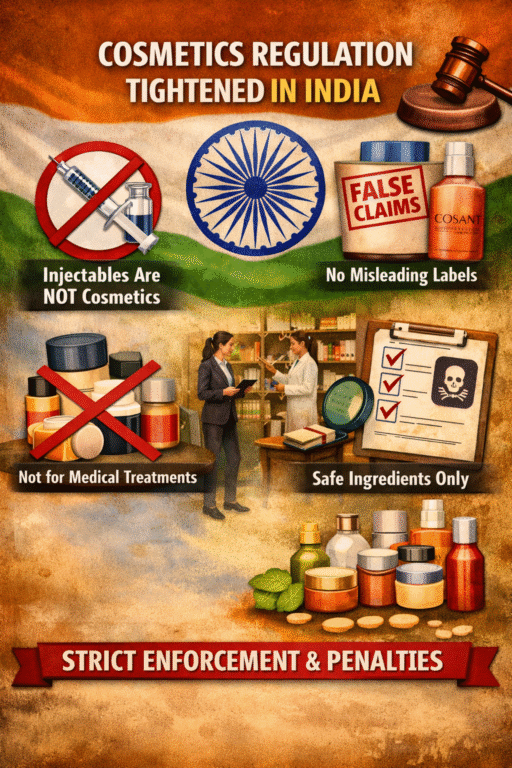
Central Drugs Standard Control Organisation (CDSCO) in its latest notification has moved to tighten oversight of the booming cosmetics industry in India, issuing unambiguous guidance on what constitutes a cosmetic product, how it may lawfully be used, and what actions violate the country’s drug and cosmetics regulations. CDSCO has issued stern warning against injectable cosmetics and misleading beauty claims.
The notice, bearing File No. COS-12/1/2026-eoffice dated 18.05.2026 and signed by Dr. Rajeev Singh Raghuvanshi, Drugs Controller General of India, was addressed to all stakeholders — consumers, aesthetic professionals, importers, manufacturers — and to all State/UT Licensing Authorities.
The regulator reaffirms the statutory definition under the Drugs and Cosmetics Act, 1940: a cosmetic is any article intended to be rubbed, poured, sprinkled or sprayed on, or introduced into, or otherwise applied to, the human body for cleansing, beautifying, promoting attractiveness, or altering the appearance — and includes any article meant to be used as a component of a cosmetic. Manufacturing and import of such products for sale and distribution is governed under the Cosmetics Rules, 2020.
Perhaps the most pointed directive in the notice: products supplied as injectable preparations fall entirely outside the legal definition of a cosmetic. No cosmetic — regardless of its formulation or marketing — is permitted to be administered by injection, whether by consumers themselves, aesthetic professionals, or clinics. The law is clear: cosmetics are only to be rubbed, poured, sprinkled or sprayed onto the human body.
Cosmetic labels must not convey any idea that is false or misleading to intending users. Altering, obliterating, or defacing any inscription made by the manufacturer on a container, label, or wrapper is expressly prohibited.
Cosmetics may only be supplied for their intended purpose — cleansing, beautifying, promoting attractiveness, or altering appearance. They may not be used as part of any medical or aesthetic treatment by professionals or individuals.
The Bureau of Indian Standards publishes and maintains the list of ingredients that are Generally Not Recognised As Safe (GNRAS) and restricted ingredients. Manufacturers and importers must ensure compliance.
The notice explicitly identifies conduct that attracts enforcement action under the Drugs and Cosmetics Act and Rules:
- Use of prohibited or GNRAS-listed ingredients in cosmetic products
- Misleading or false claims on cosmetic labels or packaging
- Use of cosmetics for medical or aesthetic treatment purposes
- Application of any cosmetic through injection by any person — consumer, professional, or clinic
The regulatory crackdown comes amid growing concerns about the proliferation of so-called “skin boosters,” mesotherapy preparations, and other injectable aesthetic products being marketed and administered under the guise of cosmetic treatments — a practice that, as this notice makes explicit, has no legal standing under Indian law.
The CDSCO encourages all members of the public, healthcare professionals, and industry to report observed violations to the Regulatory Authority at cosmetics@cdsco.nic.in and/or the concerned State Licensing Authority. Anonymous reporting is accepted through the CDSCO website.
The notice is also addressed to all State and Union Territory Licensing Authorities, signalling that enforcement is expected to be coordinated at the ground level across India. Industry observers expect increased scrutiny of aesthetic clinics, medi-spas, and online sellers of injectable skin products in the weeks ahead.
How Vaayath can help?
With increasing CDSCO scrutiny on cosmetic products and claims, Vaayath Consulting Services Pvt Ltd helps cosmetic manufacturers, importers, and marketers achieve regulatory compliance in India through cosmetic registration support, label and ingredient compliance review, GNRAS assessment, dossier preparation, GMP compliance, and regulatory audit readiness as per the Cosmetics Rules, 2020.

