
.png
)
05th May, 2026
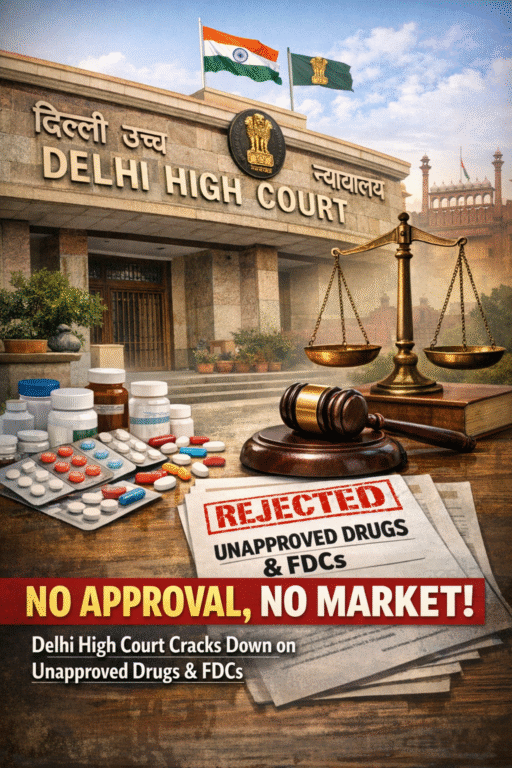
In a decisive move reinforcing India’s drug regulatory framework, the Delhi High Court has delivered a significant judgment that could reshape how pharmaceutical companies approach approvals—especially for Fixed Dose Combinations (FDCs) and other “new drugs.”
The ruling in Maxford Healthcare & Ors. vs Union of India & Ors. and connected matters is not just another legal outcome—it is a regulatory wake-up call for the entire pharma industry.
🧾 What Was the Case About?
Multiple pharmaceutical companies challenged an advisory issued by the FDC Division of the Central Drugs Standard Control Organisation (CDSCO).
This advisory directed State Drug Controllers to:
- Review approvals granted for FDCs classified as “new drugs”
- Identify licenses issued without central approval
- Take corrective actions, including revocation of licenses
The companies argued against this move—but the Court saw it differently.
⚖️ What Did the Court Observe?
The Court upheld the regulatory action and made some critical observations:
- FDCs = New Drugs (No Exceptions)
Under the New Drugs and Clinical Trials Rules, 2019:
- Any combination of previously approved drugs, when combined for the first time, is a “new drug”
- Such products must undergo central evaluation
👉 This directly places them under the authority of the Drug Controller General of India
- State Approvals Cannot Replace Central Approval
The Court acknowledged a concerning industry practice:
- State Licensing Authorities (SLAs) granting manufacturing licenses
- Without prior DCGI approval
This was clearly flagged as non-compliant and risky.
- Patient Safety Takes Priority
The judgment emphasized:
- Lack of scientific evaluation = unknown safety & efficacy
- Unapproved drugs can lead to adverse drug reactions and public health risks
The Court supported CDSCO’s position that such products cannot be allowed in the market.
- Regulatory Action is Justified
The Court upheld:
- Review of approvals
- Issuance of show-cause notices
- License cancellations where required
Importantly, it noted that:
Some companies voluntarily surrendered licenses, acknowledging regulatory gaps.
🚨 Key Takeaway: There Was No Valid DCGI Approval
One of the most striking conclusions:
The petitioners failed to demonstrate valid authorization from DCGI to market the drugs.
This single point became decisive in dismissal of the petitions.
📉 Why This Matters for Pharma Companies
This judgment exposes a long-standing regulatory grey area:
- Reliance on state-level licenses alone
- Overlooking central approval requirements
That approach is no longer sustainable.
📌 The Bigger Message: Compliance is Centralised
The Indian regulatory system—especially under the Drugs and Cosmetics Act, 1940 and NDCT Rules—clearly establishes:
👉 No new drug can enter the market without DCGI approval
This includes:
- FDCs
- Modified formulations
- New indications
- Even legacy “unapproved” products
🔍 What Should Industry Do Now?
✔️ Immediate Actions:
- Conduct a portfolio audit of all products
- Identify:
- FDCs without DCGI approval
- Products approved only by SLAs
- Initiate regularization or withdrawal
✔️ Strategic Shift:
- Make DCGI NOC a non-negotiable step
- Integrate regulatory checks in:
- Product development
- Licensing strategy
- Market entry decisions
🧠 Final Thought: “Approval First, Business Next”
This judgment is more than a legal decision—it’s a regulatory reset.
The message is clear:
🚫 State license alone is not enough
✅ DCGI approval is mandatory
Pharmaceutical companies must recognize that:
- Compliance is not optional
- Shortcuts can lead to license cancellations, litigation, and reputational damage
🎯 Conclusion: Compliance is Not Optional—It’s Foundational
The Delhi High Court has drawn a firm and unambiguous line:
👉 No DCGI NOC = No Legal Right to Manufacture or Market
This judgment reinforces a fundamental principle of Indian drug regulation:
- Central approval is supreme
- State licenses cannot override statutory requirements
- Patient safety outweighs commercial convenience
For pharmaceutical companies, this is a moment to reassess, realign, and reinforce compliance frameworks.
🚀 What Should You Do Next?
In today’s dynamic regulatory environment, visibility and expert guidance are critical:
🔍 Know Your Drug Approval Status
Before you act, ensure complete clarity on whether your product is approved, unapproved, or falls under the “new drug” category.
👉 Access real-time insights through Pharminho — your smart companion for tracking CDSCO approvals, upcoming drugs, and regulatory pathways.
🧩 Need Help with DCGI Approvals or Regularisation?
Whether it’s:
- Filing new drug applications
- Regularising legacy/unapproved products
- Responding to regulatory notices
- Navigating NDCT Rules
👉 Partner with Vaayath Consulting Services Pvt Ltd, a trusted name in GMP audits, regulatory strategy, and compliance solutions.
💡 Final Word
In light of this judgment, the industry must adopt a simple but powerful approach:
“Verify before you market. Approve before you scale.”
Because in today’s regulatory landscape—
⚖️ Compliance is not just a requirement, it’s your license to operate.
🔗 For the official notice, click here.

